

Update Overview & Timeline
The Google March 2026 Core Update represents one of the most volatile ranking shifts in recent search history. Deployed from March 27, 2026, to April 8, 2026 at 06:12 PDT, this 12-day, 4-hour rollout delivered seismic changes across both US and international markets.
Official Scope & Statement
Google released a characteristically vague official statement describing the update as "a regular update designed to better surface relevant, satisfying content for searchers from all types of sites." Notably, this was the third confirmed update in just five weeks—a historically compressed timeline that signals significant algorithmic refinement:
February Discover Update
Completed: February 27, 2026
Duration: 22 days
Focus: Discover feed optimization
March Spam Update
Date: March 24-25, 2026
Duration: Less than 20 hours
Focus: Spam & abuse signals
March Core Update
Date: March 27 – April 8, 2026
Duration: 12 days, 4 hours
Focus: Content relevance & quality
This compressed update cycle demonstrates Google's aggressive push toward deeper integration of its Helpful Content Update framework, combined with continued refinement of AI Overview deployment and knowledge panel algorithms.
Rollout Speed: Second-Fastest in Five Years
At 12 days, this update rolled out faster than most 2024-2025 core updates but slightly slower than the explosive February spam update. Google's ability to deploy major ranking changes in roughly two weeks reflects improvements in their rollout infrastructure and algorithmic consistency checks.
Volatility & Impact Scale
Record-Breaking Instability
According to Semrush Sensor data, the March 2026 Core Update reached a peak volatility score of 9.5 out of 10—among the highest ever recorded and earning the informal designation of "Googlequake" from the SEO community. A second independent source confirmed a 9.3/10 reading, validating the unprecedented nature of these shifts.
What Does 9.5/10 Volatility Mean?
A volatility score this high indicates that the majority of monitored websites experienced meaningful rank position changes. This isn't routine fluctuation—it's a fundamental reordering of search results across most vertical categories and geographies.
Breadth of Impact
Over 55% of monitored websites experienced ranking shifts during this update. In the first week alone, many sites reported organic traffic losses between 20-35%. Unlike previous updates where losers and winners were relatively balanced, this update created dramatic volatility with:
- Sharp, sudden drops in visibility (sometimes within 24-48 hours of rollout completion)
- Sustained gains for winners that gradually settled into new visibility levels
- New SERPs that in many cases replaced traditional organic results with SERP features (AI Overviews, local packs, discussion modules, product grids)
- Inconsistent recovery patterns—some sites rebounded after 2-3 days, others continued declining through mid-April
This pattern suggests Google deployed multiple concurrent algorithmic changes rather than a single monolithic adjustment. Evidence indicates:
- Deeper Helpful Content integration across all languages and regions
- AI Overview expansion affecting which sites appear in traditional organic results
- Knowledge panel & entity confidence updates that benefited established brands
- Interchangeability penalty for generic, commodity-like content
The combined effect created the observed "Googlequake"—a market reordering where authority, originality, and brand strength became decisive ranking factors.
Deep Dive: German Market (SISTRIX Analysis)
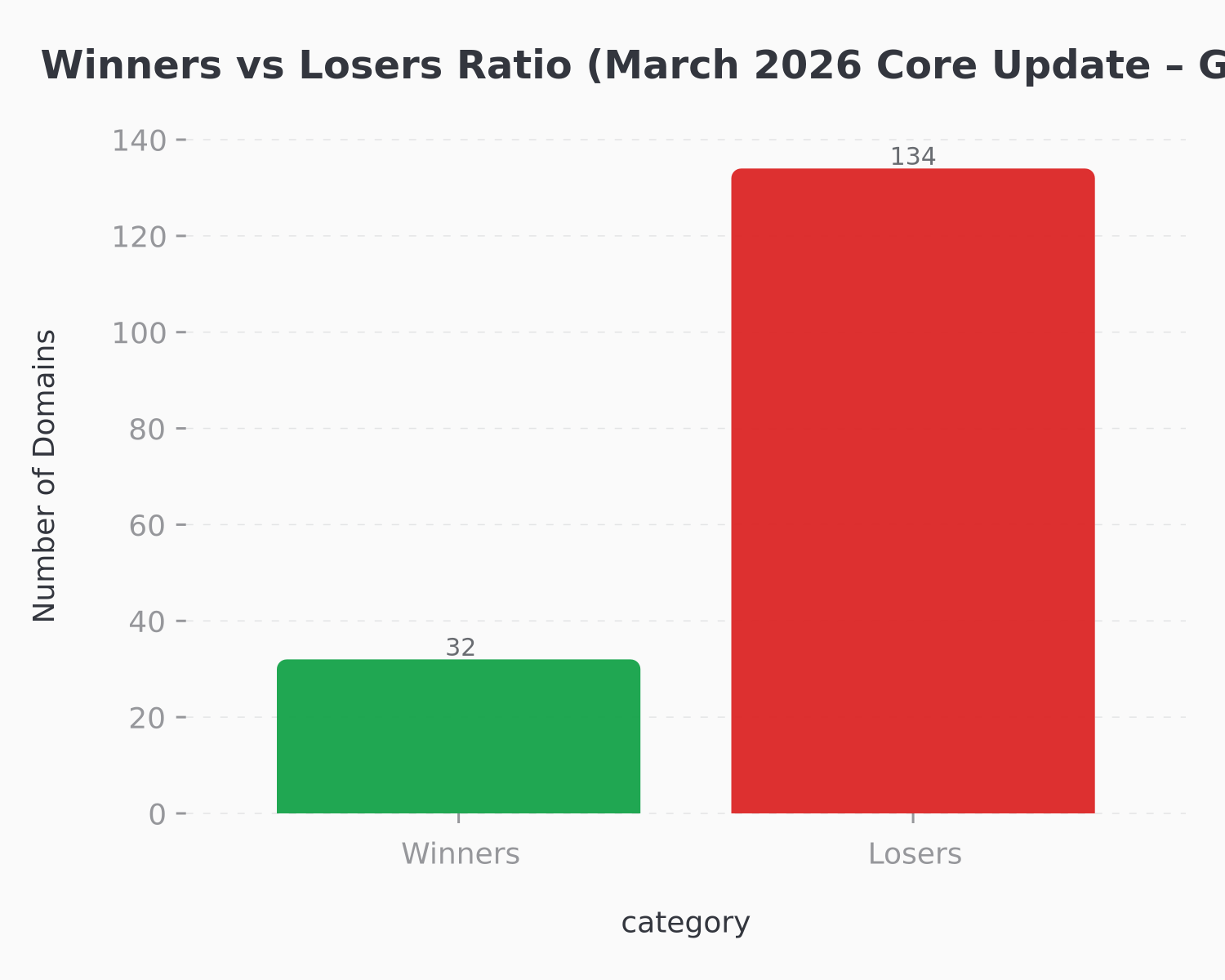
Germany's SEO market provides the clearest dataset from this update. SISTRIX tracked 1,371 domains with noticeable changes, identifying 134 validated losers and 32 validated winners. This 4:1 loss-to-win ratio indicates a selective update that rewarded specific content types while penalizing others.
Top Losers in Germany
The following domains experienced the most severe visibility declines in the German market:
| Domain | Category | SI Before | SI After | Change |
|---|---|---|---|---|
| snautz.de | Pet/Shop | 3.2 | 2.0 | -37.5% |
| media-dealer.de | eCommerce | 4.7 | 2.9 | -37.2% |
| weltfussball.de | UGC/Sports | 4.0 | 2.6 | -35.1% |
| myfanbase.de | UGC/Community | 11.9 | 7.9 | -34% |
| arlafoods.de | Brand/Food | 4.6 | 3.2 | -30.9% |
| verbformen.de | Language/Tools | 10.2 | 7.2 | -30.1% |
| cecil.de | Fashion eCommerce | 6.2 | 4.4 | -29.7% |
| kuechengoetter.de | Food/Recipe | 5.2 | 3.7 | -28.7% |
| finanzen100.de | Finance Aggregator | 15.6 | 11.4 | -27% |
| gutefrage.net | UGC/Q&A | 61.7 | 47.2 | -23.6% |
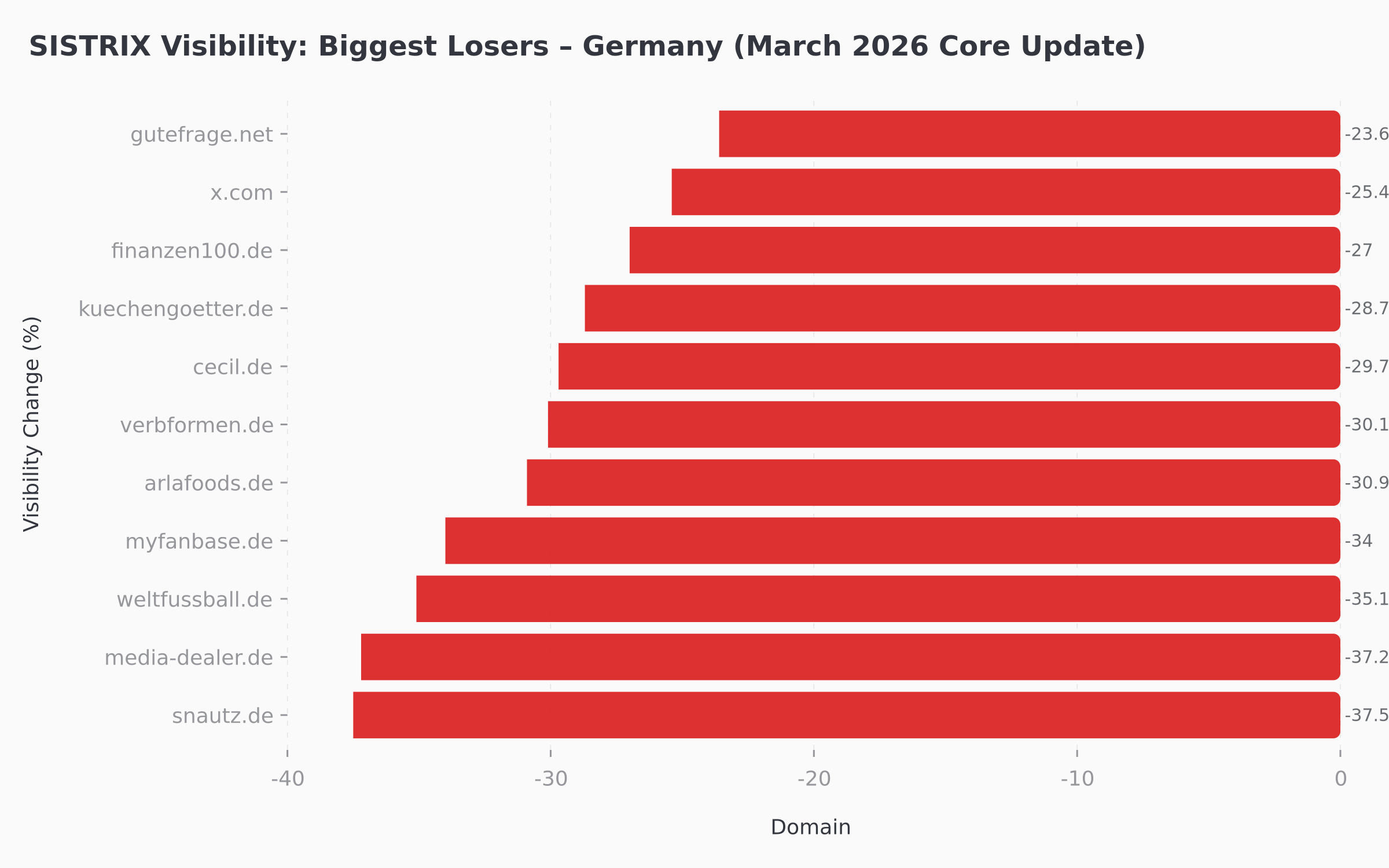
Loser Categories: Industry Patterns
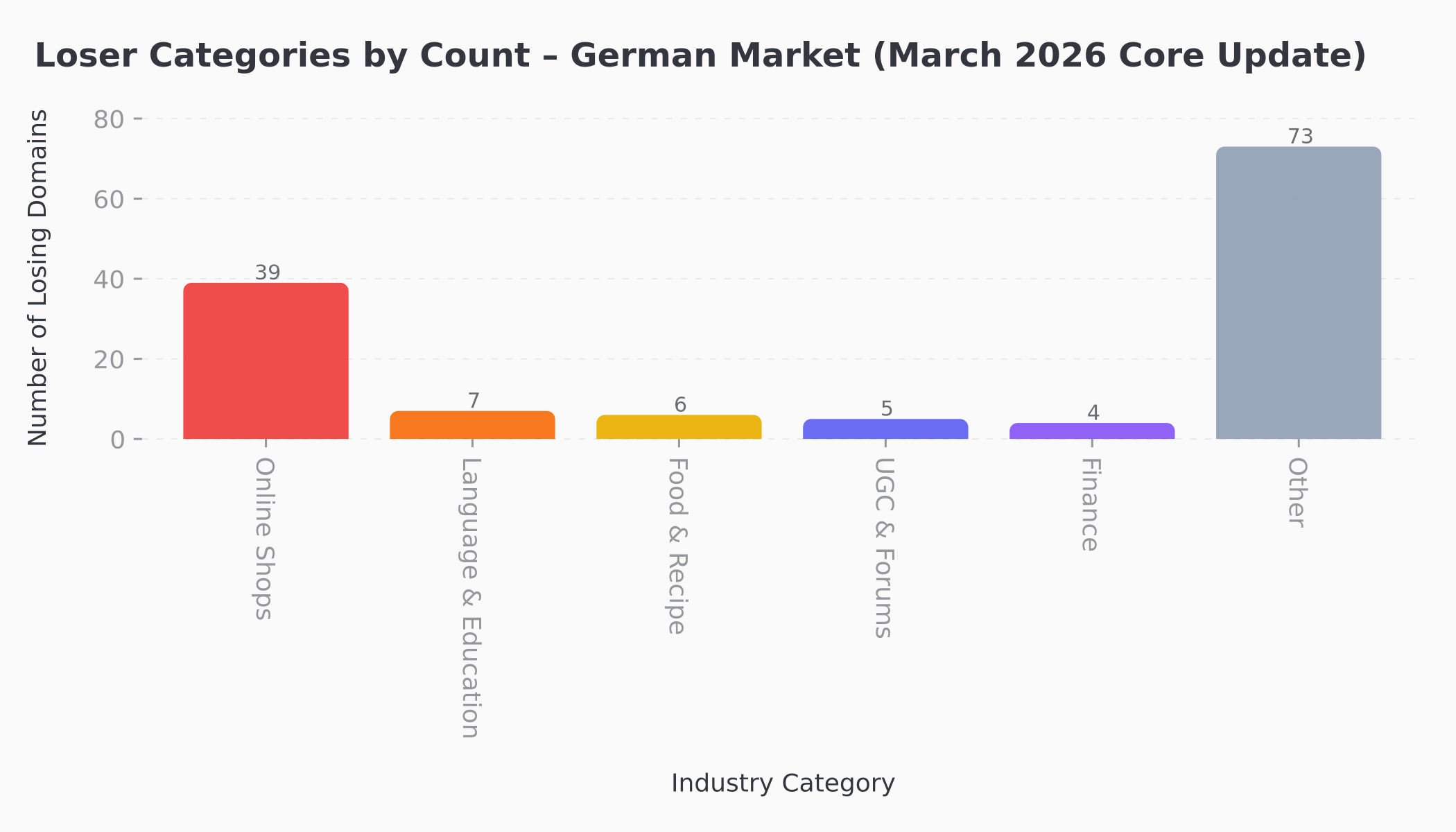
The German market losers clustered into five primary categories. Understanding why these categories suffered reveals Google's core algorithmic priorities:
1. Online eCommerce (39 domains)
Generic online retailers took significant hits. Affected sites include:
- cecil.de (-29.7%)
- happy-size.de (double-digit loss)
- alternate.de (double-digit loss)
- conrad.de (double-digit loss)
- notebooksbilliger.de (-11%)
- expert.de (-11%)
- dehner.de, samenhaus.de, otto-office.com, hygi.de
Why they lost: These sites suffer from commodity product listings with minimal unique value. Google's algorithm increasingly demands differentiation—expert curated selections, comparison content, detailed buying guides, or community reviews. Simple product feeds with manufacturer descriptions lose to specialized retailers and experts.
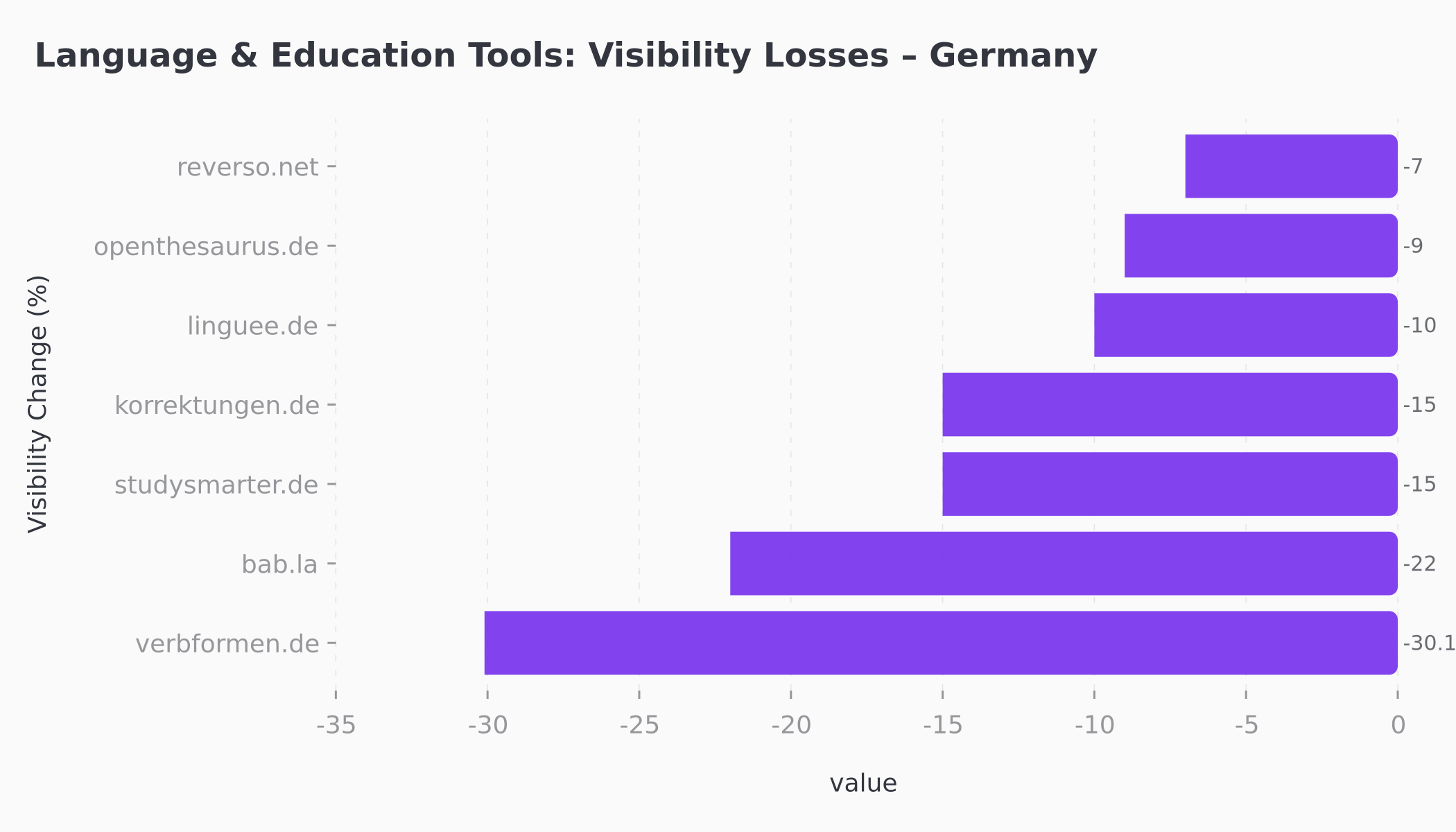
2. Language & Education Tools (7 domains)
Utility-focused language sites experienced significant declines despite historical stability:
- verbformen.de (-30.1%) — German verb conjugation database
- bab.la (-22%) — Translation platform
- korrektungen.de (-15%) — Correction tool
- studysmarter.de (-15%) — Study resource
- linguee.de (-10%) — Dictionary/translation
- openthesaurus.de (-9%) — Thesaurus
- reverso.net (-7%) — Translation/grammar
Why they lost: These sites provide utility but limited editorial value or expert curation. With AI Overviews now handling simple lookup queries directly, users no longer click through to these sites for basic conjugations, translations, or definitions. The update appears to have downranked "answer extraction" sites in favor of comprehensive learning resources with expert instruction.
3. Food & Recipe Content (6 domains, 1 notable exception)
Recipe and food reference sites showed consistent losses:
- kuechengoetter.de (-28.7%)
- schlemmer-atlas.de (-25%)
- fischlexikon.eu (-20%)
- eatsmarter.de (-18%)
- essen-und-trinken.de (-11%)
- lecker.de (-6%)
Exception: chefkoch.de remained stable, suggesting that user-generated content (UGC) with authentic community engagement outperforms corporate recipe sites.
Why they lost: Generic recipe sites with scraped or AI-enhanced content struggle against specialized food communities and expert-authored content. The update penalizes "interchangeable" recipe sites while preserving community-driven platforms where users share authentic experiences and modifications.
4. User-Generated Content & Community (Forums, Q&A)
Surprisingly, major UGC platforms also suffered:
- gutefrage.net: SI 62 → 47 (-23.6%) — German Q&A platform
- xing.com (-14%) — Professional network
- x.com (-25.4%) — Twitter (separately affected in rankings)
- weltfussball.de (-35.1%) — Sports community
- myfanbase.de (-34%) — Fan community
Why they lost: This pattern indicates Google is applying stricter quality filters to UGC platforms. The algorithm now distinguishes between high-signal community content (Reddit, Yelp performed well) and low-moderation forums where AI-generated or spam content flourishes. Community platforms with weak editorial oversight saw SERPs displaced by AI Overview answers.
5. Finance & News Aggregators
finanzen100.de (-27%) suffered despite high historical authority. Aggregator sites that republish content without original analysis were selectively demoted.
Top Winners in Germany
Conversely, 32 domains benefited from the March 2026 update. Winners cluster into distinct categories:
| Domain | Category | SI Before | SI After | Change |
|---|---|---|---|---|
| audible.de | Official Brand | 2.9 | 8.0 | +172% |
| meine-gesundheit.de | Health Authority | 4.2 | 6.0 | +43.6% |
| chatgpt.com | AI Tool | 4.1 | 5.4 | +32.1% |
| aral.de | Official Brand | 4.2 | 5.6 | +32% |
| europapark.de | Official Brand | 5.5 | 6.8 | +22.2% |
| stuttgart-airport.com | Official Brand | 6.2 | 7.6 | +22.7% |
| koeln-bonn-airport.de | Official Brand | 5.1 | 6.0 | +17.6% |
| hamburg-airport.de | Official Brand | 7.1 | 8.3 | +16.9% |
| muenchen-airport.de | Official Brand | 12.4 | 13.4 | +8% |
| ratiopharm.de | Pharma Brand | 20.6 | 23.1 | +11.9% |
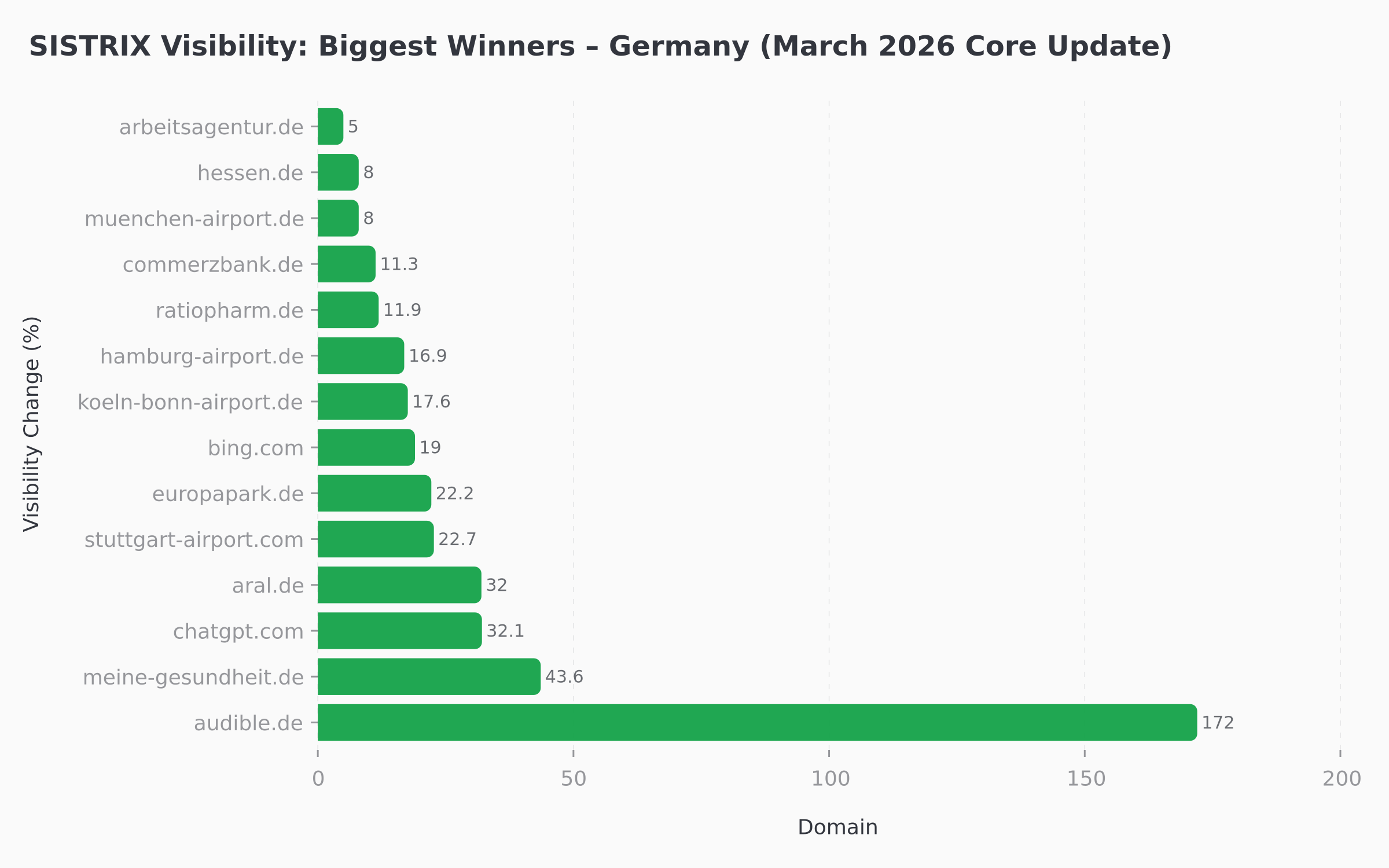
Winner Characteristics
Official brands and established authorities dominated the winners' list. The patterns are unmistakable:
Winners' Common Traits
- Official ownership: Brand-owned domains (audible.de, aral.de, europapark.de) gained massive visibility
- Authoritative sources: Health authority (meine-gesundheit.de), government sites, and established institutions benefited
- Institutional recognition: Airports (all major German airports gained visibility), official services
- AI tools & emerging platforms: ChatGPT, Google's own services, and established AI platforms expanded visibility
- Information monopolies: Where content is rare and proprietary (airline schedules, health information, entertainment catalogs), official sources won decisively
Audible.de's remarkable +172% gain is particularly instructive. This jump reflects two factors: (1) official brand prioritization for branded searches, and (2) AI Overviews displacing generic audiobook aggregators in favor of the authoritative source. When a user asks "where can I listen to audiobooks," Google now ranks the official platform higher than guides that compare services.
International Market Patterns
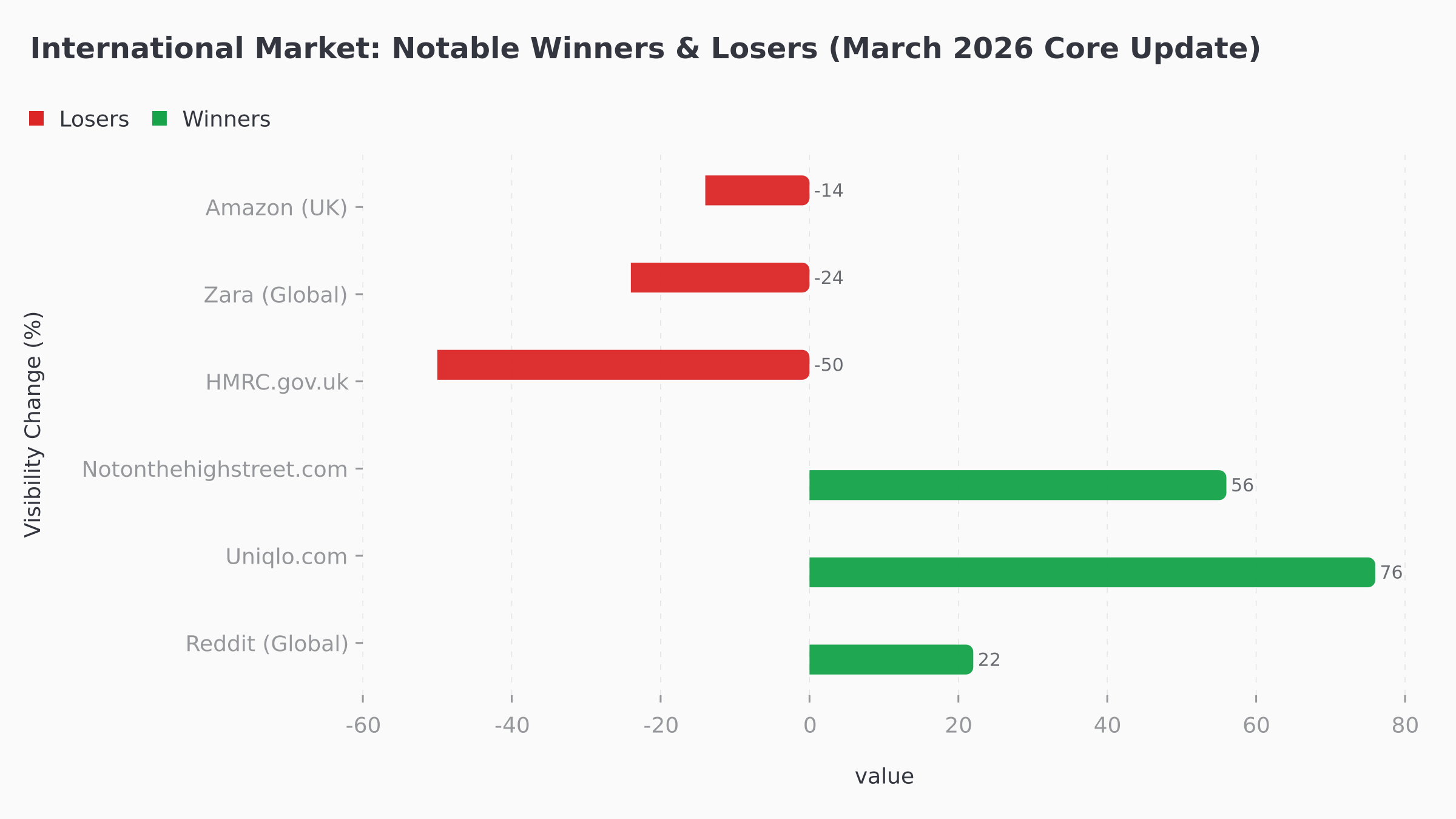
While German data provides granular detail, international patterns reveal Google's global algorithmic direction:
Winners Across Global Markets
Original Research & Proprietary Data
Publishers with first-hand research, proprietary studies, and original data outperformed aggregators. Niche publications, industry-specific blogs, and expert-led content saw average visibility gains of approximately 22%.
Established Brands with Authority
Major brand properties expanded visibility:
- Uniqlo.com: +76% visibility (official brand benefiting from e-commerce intent queries)
- Notonthehighstreet.com: +56% visibility (curated marketplace with unique positioning)
- Reddit: Expanded presence across discussion and recommendation queries
- Yelp: Increased visibility for local recommendations and reviews
AI Tools & Search Platforms
Bing.com gained +19% visibility in German search results (likely benefiting from AI Overviews integration). ChatGPT and similar AI tools benefited from queries now answered through AI Overview features rather than traditional organic results.
Global Losers
Unexpected Authority Losses
High Domain Authority sites with thin or generic content struggled unexpectedly:
- HMRC.gov.uk (UK tax authority): Lost >50% visibility despite institutional authority—suggesting thin content pages underperformed against more comprehensive resources
- Zara.com: -24% visibility (generic product listings without differentiation)
- Amazon UK: -14% visibility (algorithm deprioritizing generic product feeds)
Affiliate & Content Farm Catastrophe
The update delivered devastating impacts to affiliate and AI content strategies:
- 71% of tracked affiliate domains experienced negative impact
- Thin affiliate sites lost 60-90% visibility
- AI content mills saw double-digit percentage drops across the board
- Coupon-only aggregators and deal republishers suffered selective demotion
This pattern clearly indicates Google deployed enhanced detection for:
- AI-generated content without editorial review (no human fact-checking, minimal value-add)
- Affiliate content without first-hand experience (obvious commission-driven motivations, no unique perspective)
- Republished/syndicated content (pure aggregation without original curation or analysis)
Information Gain as Core Signal
Analysis across all markets reveals Google placed significant weight on what SEO professionals call "Information Gain"—the degree to which a piece of content teaches or reveals something new that the searcher didn't already know.
Key Ranking Patterns & Themes
"Authority Beats Interchangeability"
SISTRIX's core finding—"Authority beats interchangeability"—captures the update's essence. Google's algorithm increasingly asks: "Is this the best source for this information?"
When multiple sites could provide the same answer, Google now prioritizes:
- Official sources (brand websites, government agencies, institutional authorities)
- Expert-authored content (people with direct experience, credentials, published research)
- First-hand reporting (original research, primary sources, proprietary data)
- Specialized depth (comprehensive, detailed treatment of a narrow topic)
- Community trust signals (highly-moderated forums, verified contributors, user reviews)
Conversely, generic content loses regardless of domain authority:
- Commodity product listings (Amazon, generic retailers)
- Syndicated news/content (aggregators, republishers)
- Tool/utility sites without editorial context (dictionaries, basic converters)
- Affiliate content without original research or testing
- AI-generated content without human review
Official Sources Win Over Aggregators
A consistent pattern: when an official source (brand website, government agency, primary publisher) competes with an aggregator or guide, the official source now wins decisively.
- For products: Brand official stores > comparison sites > generic retailers
- For travel: Airport/airline official sites > travel aggregators
- For health: Medical institutions > health aggregators
- For entertainment: Netflix, Audible official sites > aggregators and guides
Market Leaders Stay Stable or Grow; Challengers Decline
There's a "rich get richer" dynamic at play:
- Market leaders (top 5 sites in a vertical) either maintained rankings or expanded visibility
- Mid-tier publishers experienced significant drops if content was generic or derivative
- Niche specialists with unique positioning and proprietary content thrived
This suggests Google's algorithm now includes strong signals for "market dominance" and "consumer trust." If millions of users consistently click a particular site for a query, the algorithm interprets that as a quality signal and reinforces that ranking.
Established Brands Benefit from Identity Confidence
Audible's +172% gain, aral.de's +32%, and europapark.de's +22% reflect not just content quality but identity confidence. Google's knowledge graphs and entity recognition increasingly treat official brand sites as authoritative sources for information about those brands.
This means:
- Official site optimization for brand queries now yields massive returns
- Brand content appears in knowledge panels with higher confidence
- Branded queries increasingly return official sites rather than third-party reviews or guides
AI Tools & Search Platforms Gain Visibility
ChatGPT, Bing, and other AI platforms gained visibility, but this likely reflects SERP feature changes rather than organic ranking improvements. As Google deploys AI Overviews more broadly:
- Traditional organic results are displaced upward (toward Featured Snippets and AI features)
- Sites that appear in AI Overview citations benefit from increased click-through
- Generic informational queries increasingly return AI Overviews instead of organic results
Two Parallel Dynamics Operating Simultaneously
The March 2026 update appears to combine two major algorithmic shifts:
Dynamic 1: Helpful Content Integration
Deeper implementation of HCU principles across all languages and geographies:
- Penalizes AI-generated content without editorial review
- Demotes affiliate content without first-hand testing
- Rewards original research and unique perspective
- Favors expert-authored content with E-E-A-T signals
Dynamic 2: AI Overview Expansion
Broader deployment of generative answer features changes SERP composition:
- More queries receive AI Overviews before organic results
- Featured snippets integrated into AI features more directly
- Traditional organic results pushed further down the fold
- Visibility shifts reflect SERP layout changes, not just ranking changes
SERP Feature Displacement as Ranking Loss Mechanism
Many reported "ranking losses" actually reflect SERP feature displacement:
- A recipe site that previously ranked #3 organically might appear only in a recipe carousel (lower visibility)
- A product page that ranked #5 might now appear in a product grid instead (displaced from organic results)
- A review site might be demoted because Yelp or Google's own review summaries now appear first
This explains why some sites with strong fundamentals (good content, established authority) still lost visibility. They weren't penalized—they were displaced by richer SERP features serving the same queries better.
What Won vs. What Lost: Content Deep Dive
Winning Content Characteristics
Original Research & Proprietary Data
Publishers that conducted original studies, surveys, or research gained significant ranking power. Examples:
- Industry reports based on proprietary data
- Original statistical research and analysis
- Case studies based on real client work
- Field research and primary source interviews
- Proprietary tools and methodologies
Expert Commentary & First-Hand Experience
Content where the author clearly had direct experience with the topic outperformed generic how-tos:
- Product reviews from verified purchasers
- Professional experience from practitioners (doctors, engineers, designers)
- Lessons learned from personal experience or case studies
- Expert credentials and publishing history
Comprehensive, Specialized Depth
Narrow, deep content beat broad, shallow coverage. Rather than "Ultimate Guide to X," winners were "Deep Dive: X for [specific use case]" or "Mastering X in [narrow niche]."
Community & Moderated UGC
Reddit and Yelp benefited because:
- Active moderation reduces spam and low-quality content
- Verified contributions (reviews tied to actual purchases, accounts with history)
- Transparent feedback mechanisms (upvotes, comments, corrections)
- Authentic author motivation (no obvious commercial incentive)
Unmoderated forums (like some instances of gutefrage.net) lost because low-quality answers weren't filtered.
Losing Content Characteristics
AI-Generated Content Without Editorial Review
Content created by AI tools without human fact-checking or editing saw systematic demotion:
- Blog posts written entirely by Claude, ChatGPT, or similar without human editing
- Content with no clear human author or expertise
- Bulk-generated content (hundreds of articles written the same day by the same person, all AI)
- Content where AI generation is obvious (generic tone, lack of specificity, cookie-cutter structure)
Important Distinction
AI tools used as writing assistants (researching, outlining, drafting—with extensive human editing) don't appear to trigger penalties. The penalty applies to minimally-edited, bulk-generated AI content. Human-in-the-loop content enhancement appears acceptable.
Affiliate Content Without First-Hand Testing
71% of affiliate domains saw negative impact. The algorithm appears to distinguish:
- ❌ Loses: "Best X" listicles with no clear evidence the author tested products, affiliate links to every product mentioned, obvious commission motivation
- ✅ Wins: Detailed reviews from verified purchasers, honest assessment of pros/cons, clear disclosure, specific use case recommendations, genuine expertise
Syndicated & Republished Content
Content republished from wire services, aggregated from multiple sources, or republished press releases without original curation lost:
- News aggregators republishing AP or other wire service content
- Content that appears on 50+ sites identically
- Press releases republished verbatim without journalist analysis
- Aggregated content without original framing or curation
Thin Utility Content Displaced by AI Overviews
Simple lookup queries (definitions, conversions, basic facts) increasingly return AI Overviews instead of traditional organic results:
- Dictionary definitions (verbformen.de, linguee.de, bab.la)
- Quick answer tools (converters, calculators)
- Simple reference content with minimal added value
These sites didn't necessarily get demoted—rather, the queries they ranked for changed fundamental SERP layout, moving them off-page.
Commodity Product Listings
Generic product pages without differentiation lost to:
- Official brand sites (better authority, trust signals)
- Specialized retailers with unique positioning
- Curated marketplaces with editorial selection
- Expert reviews and buying guides
The Information Gain Threshold
A useful framework for understanding losses: Information Gain is the degree to which content educates or informs beyond what searchers could learn elsewhere.
Low Information Gain Content: Aggregated summaries, AI-generated overviews, basic definitions, commodity product listings, syndicated articles, affiliate lists, minimal analysis, thin curation
The March 2026 update appears to enforce a higher Information Gain threshold globally. Content that barely clears the bar in 2024-2025 now loses to specialized resources with clear value-add.
7-Step Recovery Workflow for Affected Sites
If your site experienced ranking losses in the March 2026 update, this workflow prioritizes actions by impact and implementation speed. Recovery typically takes weeks to months, not days.
Step 1: Rapid Diagnosis (Days 1-2)
Identify which of three loss categories applies:
- SERP Feature Displacement: Your content still ranks but appears in a carousel, grid, or AI Overview rather than traditional organic results. Check Google Search Console "Performance" report for click-through rate changes. If CTR dropped 30-50% but impressions stayed flat, you're displaced, not demoted.
- Competitive Demotion: A competitor surpassed you with better content, authority, or specialization. Check who now ranks #1-3. If they have obvious advantages (original research you lack, stronger brand authority, more specialized expertise), you're being outcompeted.
- Algorithm Penalty: Your rankings dropped across unrelated queries suggesting content quality issues. Check for AI-generated content without editing, thin affiliate pages, obvious spam, or low E-E-A-T signals.
Deliverable: Audit 20-50 of your top-losing keywords. For each, determine: displacement, demotion, or penalty. Document the pattern.
Step 2: Content Quality Audit (Days 3-7)
For content identified as penalties, conduct deep review:
- Author Expertise Check: Does your content clearly identify the author? Are their credentials listed? Can readers verify they have expertise? Add bylines with credentials if missing.
- AI-Generation Review: Flag any content created primarily through AI without substantial human editing. Determine whether to:
- Delete (thin, low-traffic pages)
- Rewrite completely with original research and author voice
- Substantially edit and enhance with unique data/expertise
- Information Gain Assessment: For each page, ask: "What would a reader learn here that they couldn't learn by reading the top 5 competitor pages?" If the answer is "nothing," the page lacks sufficient information gain.
- Thin Content Identification: Flag pages under 800 words with minimal unique value. Assess whether they should be merged with related pages, expanded, or deleted.
Deliverable: Content inventory spreadsheet listing page URL, author/expertise, AI involvement, information gain rating (high/medium/low), and recommended action.
Step 3: Original Research & Proprietary Data Addition (Weeks 2-4)
This is high-impact but time-intensive. Prioritize top 10-20 losing pages:
- Identify data opportunities: Where can you add original data competitors lack?
- Conduct original survey or research
- Analyze your own customer/product data
- Create original statistics or benchmarks
- Interview industry experts (first-hand reporting)
- Update strategically: Rather than rewriting the entire article, add an original data section (new charts, statistics, findings) that competitors can't replicate. Cite your research in the introduction.
- Promote discovery: Feature the new original data prominently. Update the meta description to highlight it ("Includes original 2026 survey of 500+ users..." or similar).
Note: Even modest original data (survey of 50-100 users, analysis of your customer base, original case study) provides meaningful differentiation.
Step 4: Expertise & Authority Signals (Weeks 2-6)
Strengthen E-E-A-T signals across affected content:
- Author optimization:
- Add rich bylines with credentials, title, years of experience
- Link author bio to professional profiles (LinkedIn, Twitter, professional site)
- Add author photo (surprisingly impactful for trust signals)
- For health/legal content, add licensing information and credentials
- Brand authority signals:
- Add company credentials, years in business, awards
- Link to trust badges, certifications, testimonials
- Strengthen "About Us" page with company history and team expertise
- Add customer reviews/testimonials to product pages
- Content-level expertise:
- Add "About the Author" sections to long-form content
- Link to author's other published work (portfolio/portfolio links)
- Add subject matter expert interviews or quotes where relevant
- Include methodology or research process for how you created the content
Deliverable: Updated content pages with rich author/brand signals visible to both users and Google.
Step 5: Competitive Content Gap Analysis (Weeks 3-8)
For displacement losses, analyze why competitors now rank higher:
- Competitive page analysis: Review the top 5 ranking pages for each lost keyword. What do they have that you don't?
- More comprehensive coverage (longer word count, more subtopics)?
- Better structure (clearer headings, visual hierarchy)?
- Original data or research you lack?
- More recent updates/fresher content?
- Better brand authority?
- Strategic response selection: Determine what's realistic for your resources:
- Content expansion: If competitors have more comprehensive coverage, expand your content by 50-100% with new sections and insights
- Freshen & update: If your content is outdated (from 2024, last updated 2 years ago), refresh with 2026 data and examples
- Specialization: If you can't compete on breadth, narrow focus to a specific angle/niche competitors don't cover deeply
- Skip some battles: Accept that some keywords are now better answered by specialist competitors. Focus recovery efforts elsewhere
Deliverable: Content update plan prioritizing pages by recovery potential (high/medium/low).
Step 6: Moderation & Community Signals (Weeks 4-12)
If you operate community/UGC content, strengthen moderation and user trust signals:
- Increase editorial oversight:
- Review user-generated content for quality and accuracy before publication
- Remove spam, low-quality contributions, and obvious misinformation
- Highlight high-quality community contributions
- Verification systems:
- Require verification for reviewers (linked account history, purchase verification for reviews)
- Badge verified contributors
- Surface verified content higher than unverified
- Reputation management:
- Respond to low-quality contributions or corrections
- Enable community flagging/voting on quality
- Regularly audit and improve content based on community feedback
Impact note: Sites like Reddit and Yelp benefited from strong moderation. Implementing similar signals can recover rankings for community-based content.
Step 7: Long-Term Specialization & Differentiation (Weeks 8-16+)
This is the fundamental recovery strategy—becoming the specialist, not the generalist:
- Content positioning: Rather than competing on broad topics, own a specific angle:
- Instead of "Best Productivity Tools," own "Best Productivity Tools for Remote Teams" or "Best Productivity Tools for Developers"
- Instead of "Guide to X," create "X for Specific Use Case" or "X from an Expert Perspective"
- Instead of "Product Comparison," create "Product Comparison for Your Specific Situation"
- Proprietary methodologies or frameworks: Develop original frameworks, methodologies, or approaches:
- Create a unique evaluation framework competitors don't use
- Develop proprietary research methodology
- Build original tools or resources
- Author/brand specialization: Become known for expertise in a narrow domain:
- Author builds recognized expertise through consistent content and publication
- Brand becomes associated with specific niches or expertise areas
- Demonstrate longevity and consistent quality
- Strategic content gaps: Identify topics competitors underserve:
- Detailed tutorials for specific use cases
- Advanced content for expert audiences
- Industry-specific applications
- Emerging applications or uses competitors haven't covered
Timeline expectation: Steps 1-4 may show ranking movement within 2-4 weeks. Steps 5-7 typically require 6-12 weeks of consistent, high-quality content investment for meaningful recovery.
Recovery Expectations & Timeline
Fast recovery (2-4 weeks): Primarily displacement losses. Strengthen authority signals, fix thin content, improve on-page quality.
Medium recovery (4-8 weeks): Competitive demotion. Expand content, add original data, out-specialize competitors.
Slow recovery (8-16+ weeks): Algorithm penalties (AI content, thin affiliate pages). Requires significant content rewrite/deletion and brand building.
Permanent repositioning needed: Sites in declining categories (generic aggregators, commodity product lists, unmoderated forums) may not fully recover. Consider repositioning, specialization, or exiting low-signal keywords.
Conclusion & Looking Forward
The Fundamental Shift
The Google March 2026 Core Update represents a fundamental shift in how Google evaluates and ranks content. The "Googlequake" wasn't merely a ranking shuffle—it was an algorithmic recalibration toward:
- Authority over commoditization: Official sources and specialists outrank generalists and aggregators
- Originality over interchangeability: First-hand research, unique perspective, and proprietary insights beat generic rephrasing
- Expertise over automation: Human authorship with verified credentials beats minimally-edited AI output
- Information gain over information recycling: Content must teach something new, not merely repackage existing knowledge
- Trust over traffic: Moderation quality, community oversight, and reputation matter more than scale
Implications for Content Strategy
For publishers and content creators, the March 2026 update signals clear direction:
- Generalist content is higher risk. Broad "ultimate guides" face increased competition from specialists. Narrow, deep content performs better.
- Author expertise is now mandatory. Anonymous content, AI-only content, and content without clear author credentials face headwinds.
- Original research is becoming a ranking factor. As commoditized content loses, original data/research becomes a meaningful differentiator.
- Affiliate and monetization motivation is increasingly transparent. Low-quality affiliate content, coupon aggregators, and obvious commission-driven content face systematic demotion.
- Community moderation matters. Unmoderated UGC platforms lose; well-moderated communities win.
- AI-as-a-tool is acceptable; AI-as-a-strategy is risky. Using AI to assist research, outline, and draft (with heavy human editing) appears fine. Bulk-generating minimally-edited AI content is not.
What This Means for the Next 6 Months
Based on the March 2026 update patterns, expect:
- Continued pressure on thin affiliate sites and content farms. Google will likely refine AI content detection further and expand demotion of low-information-gain content.
- Growing advantage for established brands in branded queries. Official sources will increasingly dominate branded search results, reducing opportunity for third-party guides.
- Expansion of AI Overviews into more query categories. Traditional organic result visibility will continue declining for informational queries as more are answered by AI features.
- Higher bar for author/expertise signals. Bylines will become more important; anonymous or unclear authorship will face increasing friction.
- Recovery difficulty for generic publishers. Sites that built authority primarily on volume and breadth will struggle to recover without significant specialization.
Strategic Recommendations for Publishers
Immediate (Next 30 Days)
- Audit content quality; flag and fix AI-generated pages without editing
- Strengthen author credentials and expertise signals
- Delete or consolidate thin, low-traffic pages
- Update outdated content with fresh data
Medium-Term (30-90 Days)
- Conduct original research for top-losing keywords
- Expand/rewrite pages competing on broad topics; specialize narrowly
- Strengthen community moderation and verification systems
- Build author/brand authority through consistent specialization
Long-Term (90+ Days)
- Develop proprietary methodologies or tools
- Build recognized expert authority in specific niches
- Create content only you can create (proprietary data, exclusive access)
- Shift from volume to quality; reduce content production, increase depth
The Broader Context
The March 2026 update occurs within a larger trend: Google is systematically reducing the value of generic, commoditized, and high-volume content strategies. The company has made clear through a series of updates (September 2023 HCU, March 2024 core update, November 2024 spam update, March 2026 core update) that:
- AI-generated content without human review doesn't meet quality standards
- Thin affiliate and aggregation content lacks information gain
- Scale and domain authority alone don't justify ranking generic competitors above specialists
- First-hand expertise and original research are increasingly mandatory for top rankings
Publishers who adapted their strategies around these signals—moving to specialization, adding original research, strengthening author expertise—saw minimal impact from the March update. Those who continued broad, generic, or AI-dependent strategies saw severe drops.
Recovery Is Possible—But Requires Fundamental Repositioning
Sites affected by the March 2026 update can recover, but recovery requires honest assessment of competitive positioning. Generic sites competing on broad topics face the greatest difficulty. Specialists with unique positioning, original data, and clear expertise recover faster and achieve stronger long-term rankings.
The winning strategy going forward isn't "create more content"—it's "create content only you can create." Differentiate on expertise, original research, and specialization. Let generalist aggregators struggle with AI Overviews and algorithm changes. Build authority in specific domains where you have clear competitive advantage.
The March 2026 Core Update was significant not because of its volatility, but because of what it revealed: Google's algorithmic future belongs to specialists, not generalists; to authorities, not aggregators; to original research, not repackaged information.