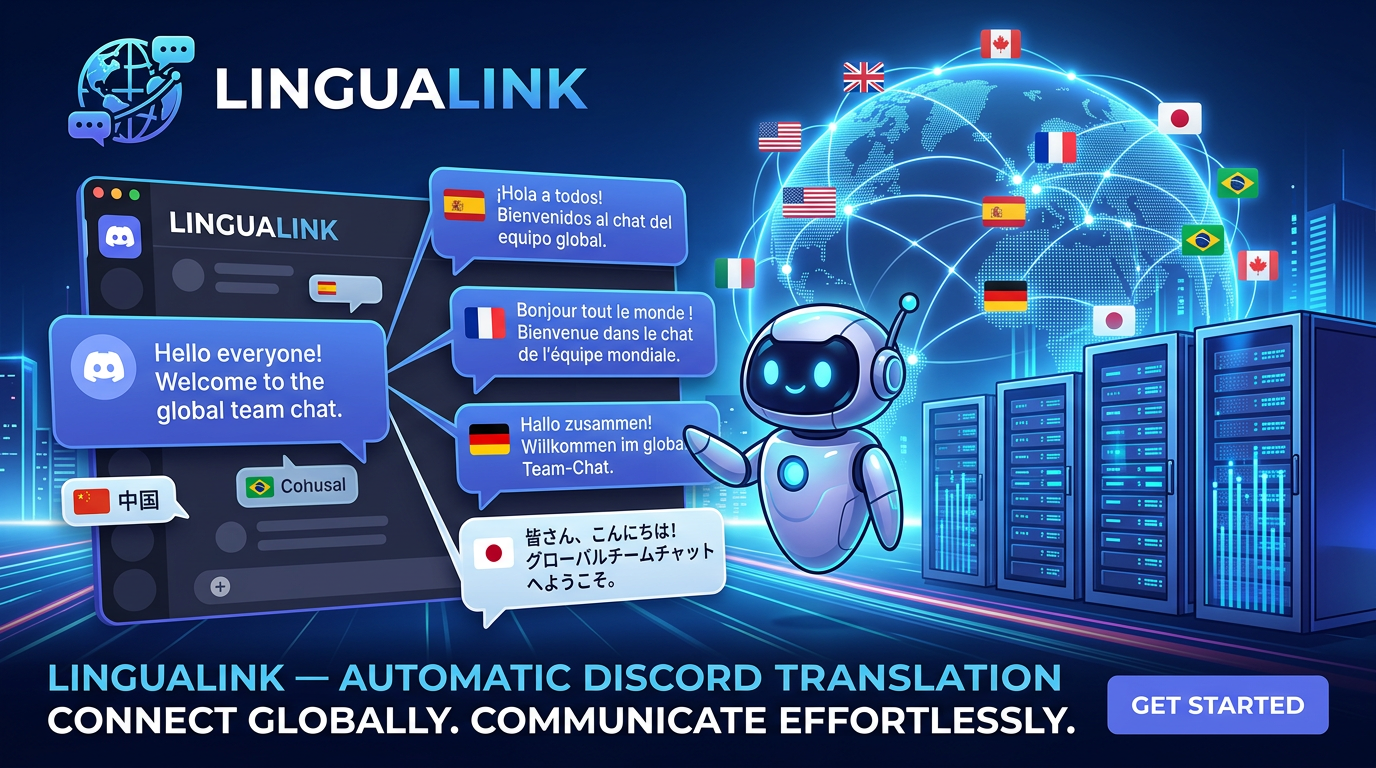
I built a Discord bot because global gaming chat still feels broken.
LinguaLink started as a simple experiment: could I build a Discord translation bot that feels natural inside real gaming communities instead of acting like a clumsy external layer? I wanted something faster, more controllable, more privacy-conscious, and much more aware of how gamers actually talk.
Configured directly in the bot and loaded into the self-hosted translation stack.
Script-aware logic helps avoid pointless translations and improves readability across communities.
The bot, web layer, and LibreTranslate all run on my own infrastructure.
I did not want a generic translation bot that translates everything blindly and turns gaming chat into a mess. In live servers, context matters. A message like "gg", "nice clutch", "rush B", or "wp team" should not be treated the same way as a long Japanese or Arabic message that teammates genuinely cannot read. That difference is exactly where most bots fall apart.
The core idea behind LinguaLink: translate what actually needs translation, protect what should stay untouched, and keep the flow of the conversation intact.
What I actually built
Under the hood, LinguaLink is not just a Discord bot with a translation endpoint glued onto it. The project uses a Python bot, a self-hosted LibreTranslate service, its own persistence layer for server and user settings, language detection with lingua, and an extra protection system for the parts of Discord chat that should never be mangled by translation.
- Automatic channel translation with
!tr auto <code> - Per-user language preferences with
!tr lang - Reply-based manual translation with
!tr this - Language detection and status commands for debugging and transparency
- Protected handling for gaming terms, emojis, mentions, URLs, code fragments, and Discord-specific syntax
- Script-aware translation logic for Latin, Cyrillic, CJK, Arabic, Indic, and Greek text
Why it is better for gaming servers than most generic translation bots
The biggest difference is that LinguaLink was built around how people actually communicate in Discord gaming channels. That sounds obvious, but most bots still behave as if every message were clean business prose.
Terms like gg, clutch, buff, rush, and noob are treated as part of the game language, not random words to be rewritten badly.
Custom emojis, mentions, URLs, and other Discord-specific elements are protected before translation and restored afterward.
The bot uses script-aware logic, so it does not overreact to every tiny message when translation would add no value.
Not every channel needs full automation. Manual translation is there when someone only wants help with one specific message.
Why I deliberately did not use a third-party translation API
This was one of the most intentional decisions in the whole project. I could have built the bot faster by sending every message to an external translation API and paying per request. But I explicitly did not want that architecture.
Discord bots can generate a surprising amount of traffic. Per-call pricing sounds fine until active communities start producing thousands of short messages per day. Self-hosting gives me far more predictable operating costs.
I did not want every chat message to be forwarded to an outside API by default. Even if a provider is reputable, it still creates a bigger external data flow than I wanted for this experiment.
Self-hosting does not automatically make a project compliant, but it gives me much more control over where messages go, what gets processed, what gets stored, and how I document the setup. That is a lot easier to reason about than routing everything through another vendor.
If the entire product depends on one external API, the roadmap and cost structure are no longer really yours. I wanted the freedom to change logic, providers, hosting, and guardrails without rebuilding the bot from scratch.
The project is not just "translate text". It protects gaming slang, preserves Discord objects, and decides when a translation is worth showing. That is much easier to shape when the translation layer is part of the system, not a remote black box.
I wanted to learn what happens when translation is treated as infrastructure and product design, not just as an API integration. That is where the interesting part starts.
Important nuance
I am not claiming that external APIs are bad or unusable. They are often the fastest way to ship. But for this project, I cared more about control, flexibility, and privacy-conscious architecture than about the absolute shortest implementation path.
What I like most about the experiment
LinguaLink is not trying to be the biggest Discord bot on the platform. What I like about it is that it solves a very practical problem in a more opinionated way. It is built for multilingual communities that want to keep the spontaneity of live chat. It is not optimized for flashy AI marketing. It is optimized for the moment when a teammate writes in a language you cannot read and the conversation still keeps moving.
That is why I call it an experiment. It sits somewhere between bot design, localization, community UX, and infrastructure work. And to me, that is exactly what makes it interesting.
I built LinguaLink because I wanted international Discord servers to feel less fragmented. If the bot does its job well, people stop thinking about translation and just keep talking. That is the standard I care about.
If this experiment keeps proving itself, I will keep pushing it further.